Wednesday, 10 February 2016

Games Production - Researching Abandoned Facilities
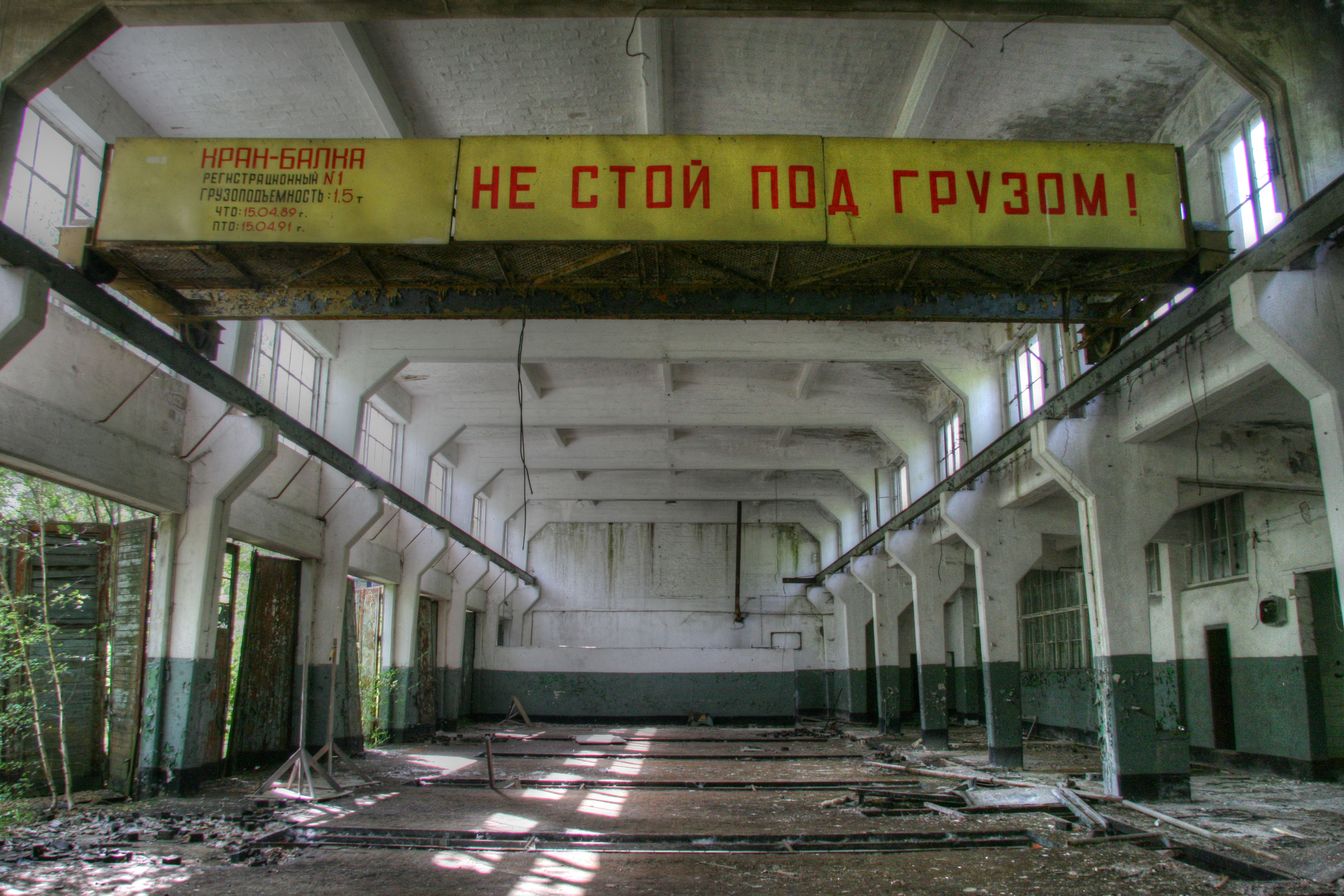
We were sent off by the game designer to gather research for the game. As the idea was that your character was suppose to navigate their way around a research and development facility, I decided to go away and look at what abandonment does to buildings. This was a great piece of research, especially with me being one of the environment artist. It gives me a sense of what the rooms should look like and what the player should experience as they navigate their way around the map.
 |
| A real life Abandoned Laboratory. |
 |
| An Abandoned Barracks in Berlin. |
As we had many different rooms to feature in the level, there was a huge variety in which I had to look at. Not all the rooms look the same, the time has taken its toll on these rooms. One thing we had all decided on is that the rooms have only just been abandoned, with your character being a first response to the attack. This means, unlike some of these rooms, there will be no plant life growing or rust starting to attack the machinery.
One thing that is common in all of these pictures, is that a story is being told in every aspect of the rooms. You can evidently see something has placed items there and left them to rot, on no fault of their own. If we are to create a realistic experience with this game, then we need to think outside of the box when it comes to placing the assets, not just randomly placing objects hoping that it works.
 |
| A mood-board of Abandoned facilities. |
This has been a great process as I now have an idea of what the game will look like. It has also given me an idea of what makes all these images so captivating and how we can incorporate into the environment. Also if we want to save on tri's, a modular environment needs to be constructed and in the abandoned space station images, we would have to construct one piece of a wall and then repeat over to construct our environment.
Games Production - Game Design Document (1st version)
We were told that we would have to construct a game design document for the game. This would outline what we plan to do with the game and what inspiration we can draw on. The game design document is also essential as it gives us a plan to follow, something that we can stick to or refer back to, if we ever get lost on the project and fall off the path. In this Game Design Document, we are aiming to set out the main premise for our game and this document will act as a template for us to follow.
 |
| Example of the game design document (The X, The 4 Pillars, Story). |
-Content
-Scope
-Conventions
-The X
-The 4 Pillars
-Story
-Art Direction
-System Requirements
-Software
-SDKS
-The Player/Core Mechanics
-Controls, World
-Landscape
-Objects
-NPCS
-Sound
-Game Flow
-The Player
-Setting
-Game Structure
-Action
-Objective
-Graphics
-HUD
-Limitations
-Intro
-Menu System
-The Team
-References
 |
| System requirements, Software, SDKS. |
Sunday, 7 February 2016
Working on the room.
So After I did the design of the room it was time to go and do some parts which were not visible in the first concept from different angles.


\


Saturday, 6 February 2016
Games Production - Milestone 1
For this milestone, we had to propose our game idea to our producer and to the rest of our class. However, since I had already completed an early prototype over Christmas, I was able to present a small gameplay prototype that I had been working on since we had returned for term two. My main focus since then had been developing the enemy behavior so that there is a stronger structure to the gameplay.
The behavior of the enemies is controlled by a finite-state machine. Basically there's a bunch of cover points around the map that raycast to the player to determine whether or not they are a 'good' or 'bad' cover point. They also raycast from a 'shoot from cover' point to determine whether or not the enemies can pop out and shoot the player from this point.

The behavior of the enemies is controlled by a finite-state machine. Basically there's a bunch of cover points around the map that raycast to the player to determine whether or not they are a 'good' or 'bad' cover point. They also raycast from a 'shoot from cover' point to determine whether or not the enemies can pop out and shoot the player from this point.
The enemies simply try to find the nearest 'good' cover point that they can shoot you from and that isn't currently in use by another enemy. If there are none, then they start moving to random 'non-cover' points on the map that they'll be able to shoot you from.

Wednesday, 3 February 2016
Part Three: Ben Matthews. Environment Artist.
I modeled an early, modular, floor panel concept given to me by Razvan Prajanu. This was part of the early experimentation I did to try and figure out ways to lower the number of tris in the scene. I also experimented with Quixel in order to gain a deeper understanding of PBR workflows. And to demonstrate to the rest of the team ways in which we could go about creating the environment.


This is the finished modular panel in 3DO, I used a colour ID map to assign the material. I stuck to Razvans concept best I could whilst creating this. But after a brief discussion with the team we decided not to use this panel in the environment.
Monday, 1 February 2016
Some changes of plans.
So, after some discussions we decided to change the idea of the game. We choose to kinda get rid of the big base and just do 1 or 2 rooms that will be really detailed.
We choose this after some discussions with one of our teachers. So we will try to get everything looking good in the engine and to be fun to play (not to think of the overall story).
After that I went and did a design of the room. This is how our room would look like, but nothing is decided yet, so our environment artist can go and do what modifications he considers to be better for the visual of the game and the gameplay.

Process

Subscribe to:
Posts (Atom)